Machine Learning
Support-Vector Machines
The structure to implement an SVM is available by including the header teil/model/svm/svc.h for classification problems or the teil/model/svm/svr.h for regression problems.
The existing svc_model_t and svr_model_t structures are equal, except that the svc_model_t will include arrays to hold the amounts, rnges, and a variable to store the number of classes.
The structures are the following:
typedef struct{
    unsigned int n_support;
    unsigned int n_intercepts;
    unsigned int n_classes;
    unsigned int n_features;
    unsigned int * amounts;
    unsigned int * ranges;
    enum KERNELS kernel;
    unsigned short int  degree;
    feature_type coef;
    feature_type gamma;
    feature_type * sample;
    feature_type * kernels;
    void * support_vectors;
    void * weights;
    feature_type * intercepts;
    feature_type * decision_rules;
} svc_model_t;
typedef struct{
    unsigned int n_support;
    unsigned int n_features;
    enum KERNELS kernel;
    unsigned short int  degree;
    feature_type coef;
    feature_type gamma;
    feature_type * sample;
    feature_type * kernels;
    void * support_vectors;//[][];
    feature_type * weights;
    feature_type intercepts;
    feature_type decision_rules;

} svr_model_t;
The next sections explain what each structure field maps regarding the original SVM model.
Structure Reference (Linear Kernel)
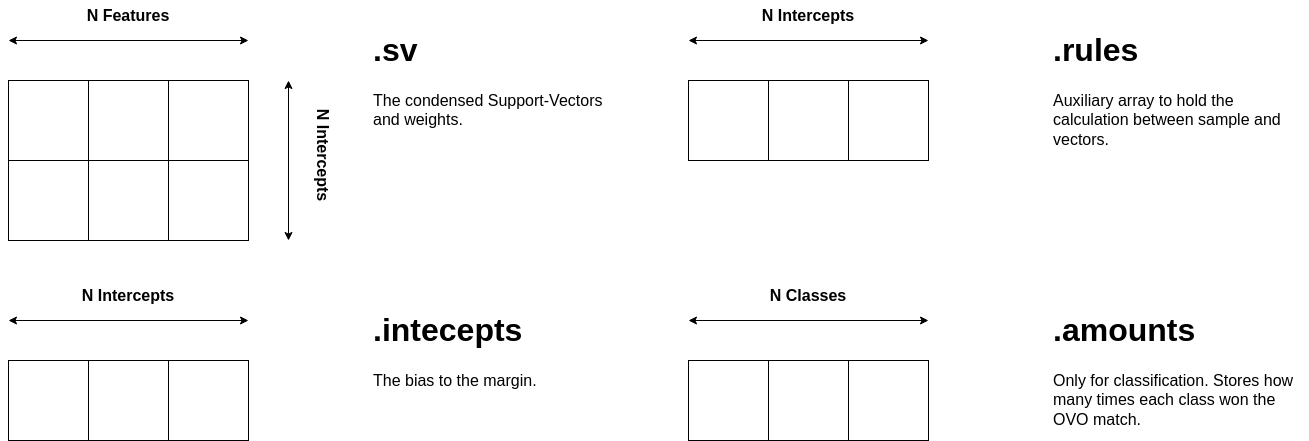
The following figure depicts the Linear SVM structure and the respective explanation. If you use other ML library but Scikit-Learn, please ensure that you copy each structure correctly. Follow the Scikit-Learn documentation to further understand what each structure represents.
Structure Reference (Other Kernels)
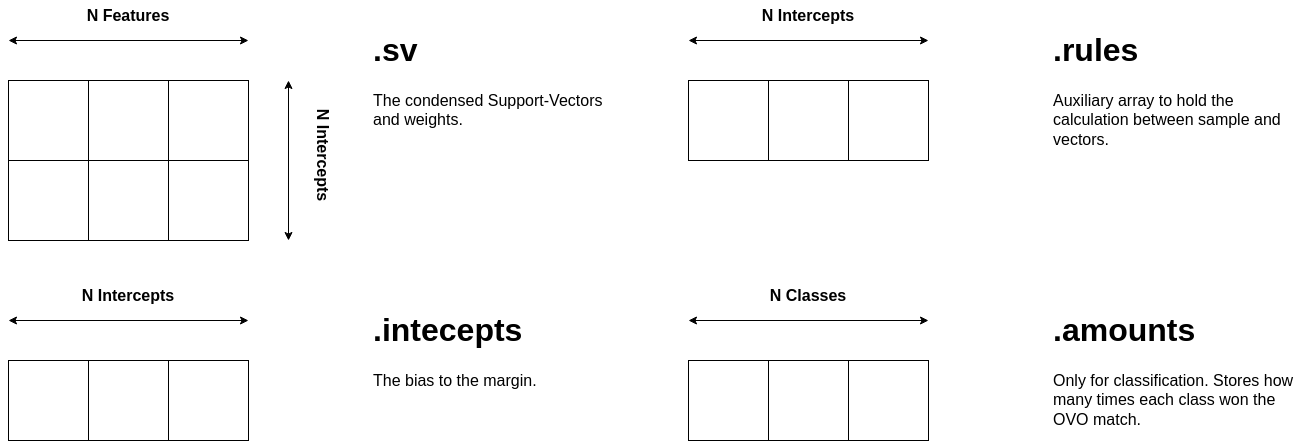
The following figure depicts the SVM structure and the respective explanation. If you use other ML library but Scikit-Learn, please ensure that you copy each structure correctly. Follow the Scikit-Learn documentation to further understand what each structure represents.
Multi-Layer Percepton
The structure to implement an MLP is available by including the header teil/model/neural_network/mlpc.h for classification problems or the teil/model/neural_network/mlpr.h for regression problems.
typedef struct{
    unsigned int n_features;
    unsigned int n_classes;
    unsigned int n_layers;
    feature_type *sample;
    mlp_hidden_layer_t ** hidden_layers;
} mlpc_model_t;
typedef struct{
    unsigned int n_features;
    unsigned int n_layers;
    feature_type *sample;
    mlp_hidden_layer_t ** hidden_layers;
} mlpr_model_t;
The mlp_hidden_layer_t is accessible by including the teil/model/neural_network/neural_utils.h header file.
Structure Reference (Hidden Layer)
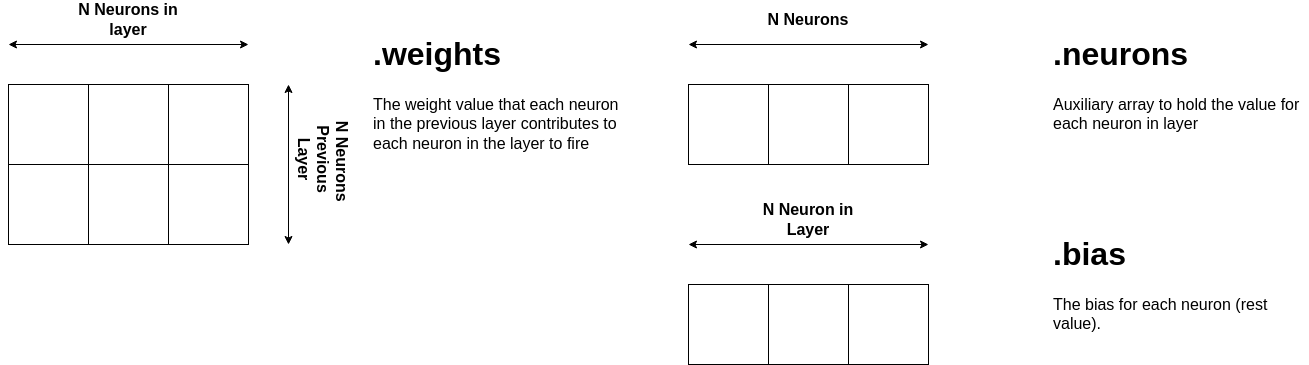
The following figure depicts the MLP Hidden Layer structure and the respective explanation. If you use other ML library but Scikit-Learn, please ensure that you copy each structure correctly. Follow the Scikit-Learn documentation to further understand what each structure represents.
Decision Tree
Decision Trees can be represented using distinct data structures. Inline If code is the straightfoward mechanism to transpile the DT model, and a single hard-coded function for each DT model is generated. Neverthless, multiple architectures may benefit from using a different DT representation, and one provides an Linked-List and an Araay representation.
Structure Reference (Array)
The following figure depicts the DT structure and the respective explanation. If you use other ML library but Scikit-Learn, please ensure that you copy each structure correctly. Follow the Scikit-Learn documentation to further understand what each structure represents.